Vodka: Origin, Production, and Cigar Pairing
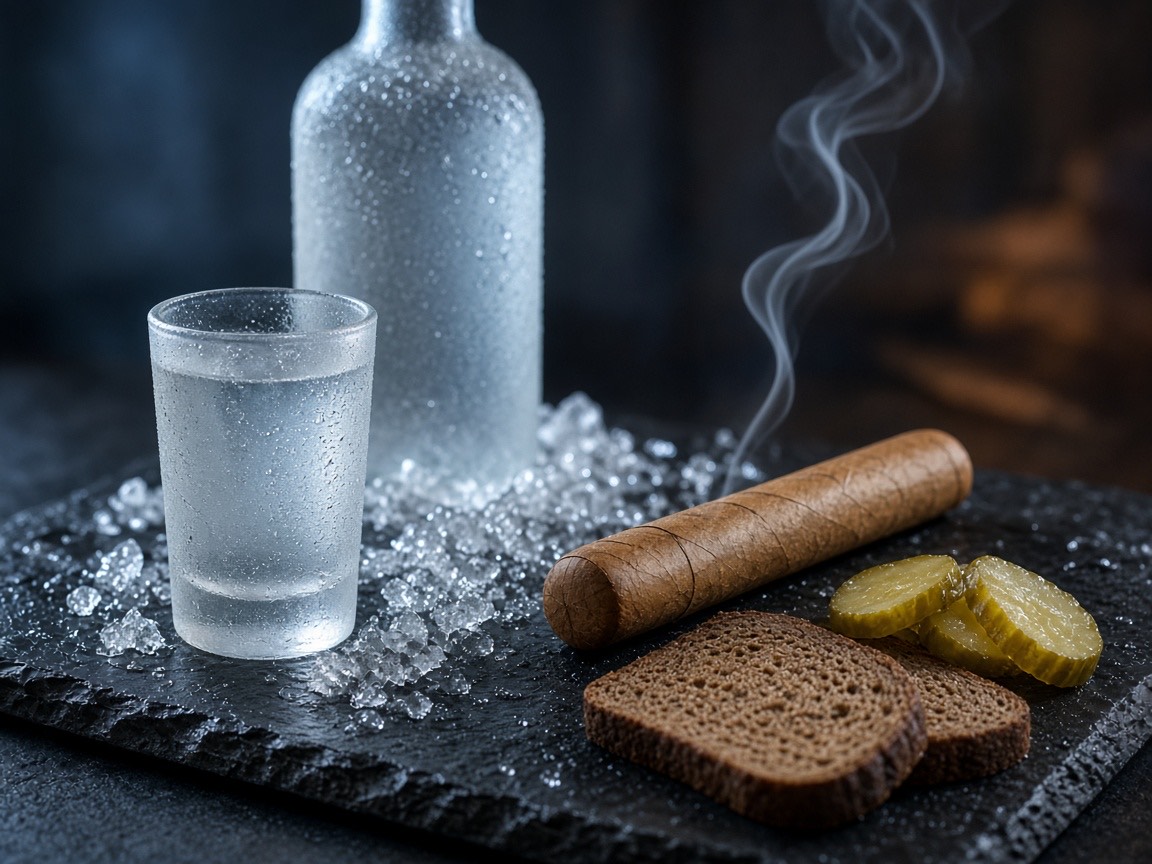
Let's be honest up front: vodka is not a classic cigar pairing. Our whole approach to pairing is that the drink and the cigar should each make the other better, and most vodka is designed to taste of very little. But that doesn't mean it's useless with a cigar. Good vodka has more character than people think, and used the right way, it can be a clean, refreshing companion to a mild smoke.
Origin
Poland and Russia have argued for centuries over who invented vodka. The name in both languages is a diminutive of "water" (woda in Polish, voda in Russian), so it means something like "little water." Polish court records from Sandomierz mention wódka in 1405, though probably as a medicine. Russian tradition credits monks in Moscow with distilling grain spirit in the 1400s. Like most of these stories, the details are hard to prove.
Early vodka was often harsh and flavoured with herbs, honey or fruit to make it palatable. Over time, distillers learned to make purer spirits through repeated distillation and charcoal filtering. Vodka became central to life in Russia, where the state held a vodka monopoly at various times. It only took off in the West after the Second World War, eventually becoming one of the best-selling spirits in the world.
Where It's Traditionally Made
Vodka's traditional home is the "vodka belt" of Eastern and Northern Europe: Poland, Russia, Ukraine, Belarus, the Baltic states and Scandinavia. Sweden gives us Absolut, Finland gives us Finlandia, and Poland is known for Belvedere, Chopin and Żubrówka (bison grass vodka). "Polish Vodka" is a protected designation that must be made in Poland from Polish rye, wheat, barley, oats, triticale or potatoes. Today vodka is made all over the world, including popular brands from France (Grey Goose), the Netherlands (Ketel One) and the United States (Tito's).
How It's Made
Vodka can be made from almost anything that ferments. Grains (wheat, rye, corn, barley) and potatoes are traditional, but grapes, sugar beet and even milk whey are also used. The raw material is fermented and then distilled to a very high strength, typically around 95 to 96% alcohol, usually in column stills. At that strength, most of the flavour from the raw material is stripped away.
Many vodkas are then filtered, often through charcoal, to remove remaining impurities and smooth the texture. The spirit is diluted with water to bottling strength: at least 37.5% in the European Union and 40% in the United States. Vodka is not aged. Interestingly, the US used to define vodka as having "no distinctive character, aroma, taste or colour." That wording was dropped in 2020, recognising that good vodka does have character.
What It Tastes Like
Vodka is subtle, but the base ingredient still shows through in better bottles:
- Rye vodka – spicy, peppery and bready, with a firm finish (Belvedere, Sobieski).
- Wheat vodka – soft, light and slightly sweet, sometimes with a hint of anise (Grey Goose, Ketel One).
- Potato vodka – creamy, full-bodied and earthy (Chopin Potato).
- Corn vodka – round and gently sweet (Tito's).
Texture matters a lot with vodka. Served ice cold, a good vodka becomes thick and almost syrupy.
What to Look for in a Cigar
Since vodka brings little flavour of its own, think of it as a palate cleanser rather than a flavour partner. Its job is to refresh your mouth between puffs, so you taste the cigar more clearly.
Strength: Mild to medium. A strong cigar won't interact with the vodka at all. It will simply dominate it, and the alcohol can make a full-bodied cigar feel harsh.
Wrapper: Connecticut shade wrappers are the natural choice. Their cream, light cedar and gentle sweetness complement the soft, clean texture of a chilled wheat or potato vodka.
Flavours to look for: Cream, butter, light nuttiness, cedar and a touch of sweetness. With a peppery rye vodka, a cigar with a little white pepper can make a nice echo.
Example cigars:
- Ashton Classic – smooth and creamy, a refined match for an ice-cold wheat vodka.
- Montecristo White Series – mild to medium Connecticut with cream, cedar and light spice. Good with a rye vodka like Belvedere.
- Oliva Connecticut Reserve – creamy and nutty, a nice partner for a richer potato vodka like Chopin.
A few tips:
- Serve vodka straight from the freezer, neat, in small glasses. The cold thickens the texture and tames the alcohol.
- Flavoured vodkas open up more options. Vanilla, coffee or citrus vodkas can be matched to cigars with the same notes.
- If you really want a flavour pairing, a vodka martini with a twist of lemon and a Connecticut cigar is a classic combination.
If you're looking for a white spirit with more to say, read our gin pairing guide or our tequila guide, or review the basics of how we pair.